Jet Ski in Tenerife: What to Watch Out For Before You Book (2026 Guide)


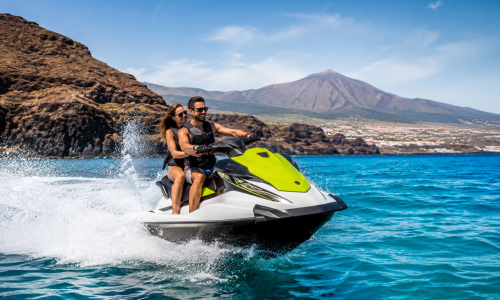
A jet ski ride along Tenerife’s south coast is one of those holiday moments people talk about for years afterwards — volcanic cliffs on one side, a thousand metres of open Atlantic on the other, and a Sea-Doo under you doing exactly what you tell it to. It is also, quietly, one of the activities where holidaymakers most often get caught out: by rules they didn’t know existed, by weather they couldn’t read, by “one hour” that turned out to be twenty minutes on the water, or by a beach tout who took cash and disappeared.
This guide is written from the perspective of an operator who runs these tours every week out of the south of the island. It covers the legal side, the safety side, the money side and the practical side — everything worth checking before you hand over a booking deposit. If you’d rather skip straight to a route that’s already sorted, our Jet Ski Tenerife experience runs from Las Galletas along the Palm-Mar coast to the Punta de Rasca lighthouse.
The 60-second version
- You cannot legally hire a jet ski alone in Tenerife without a nautical licence. Guided is not an upsell — it’s the law.
- No licence needed if you ride with a guide. Drivers must be 16+ (16–17 with parental consent), minimum height around 1.25 m.
- Weight limits apply: roughly 120 kg on a single, 180 kg on a double.
- Book morning slots — the south coast trade wind builds through the afternoon.
- Ask what “one hour” means. Water time and total activity time are two different numbers.
- Check whether pickup, fuel, wetsuit, photos and insurance excess are included.
- You’ll be riding beside a protected marine zone. Approaching whales and dolphins carries real fines.
- Never book from a beach tout. No paperwork, no insurance, no comeback.
1. The licence rule nobody tells you about until you arrive
This is the single biggest surprise for visitors. People arrive in Costa Adeje picturing themselves collecting a jet ski from a pontoon and disappearing off towards Los Gigantes for the afternoon. That is not how it works here.
Under Spanish maritime rules, operating a personal watercraft independently requires a nautical licence — a PNB, PER or a recognised international equivalent. Without one, you may still ride, and you still control your own throttle, but you must do it on a supervised route with a qualified guide leading the group. The south coast is busy with swimmers, ferries, whale-watching catamarans and fishing boats, and both the regulations and the insurance policies reflect that.
So the honest position is:
- No licence? You ride your own machine, at real speed, on a guided route. This is what almost every visitor does.
- Licence in hand? Bring the original document, not a photo. Some operators will then rent to you freely, usually against a security deposit.
If a company offers you unsupervised hire and doesn’t ask to see a licence, treat that as a red flag rather than a bargain. It usually means their insurance wouldn’t cover you if something went wrong.
2. Age, height and weight limits — check before you pay, not on the pontoon
These limits exist because a jet ski is a powerful machine that needs a rider who can reach the controls and stay on it. On our own jet ski tour the rules are:
- Drivers: 16 years and over. Riders aged 16 and 17 need written parental consent.
- Minimum height: 1.25 m — this applies to passengers too, not just drivers.
- Maximum weight: 120 kg on a single ski, 180 kg combined on a double.
- Swimming: everyone on board should be a confident swimmer, even with a life jacket.
The classic family disaster is booking for four and discovering on arrival that the youngest child is a few centimetres short. There is no negotiating this — insurance conditions are fixed. Measure at home, and if you’re travelling with younger children, look at something with a lower threshold instead, such as kayak and snorkel in Palm-Mar or stand up paddle.
3. Where you launch from changes the whole experience
Tenerife’s south coast has several jet ski bases and they are genuinely not equivalent.
Puerto Colón, Costa Adeje
The busiest and most central marina. Convenient if you’re staying in Adeje, but the water immediately outside is crowded with boat traffic, and many of the products sold here are short circuit rides close to the harbour — sometimes as little as twenty minutes.
Las Galletas / Marina del Sur
Quieter, less commercial, and the gateway to the wilder stretch of coast towards Palm-Mar and Punta de Rasca. Routes from here tend to be genuine open-ocean runs rather than laps of a bay. This is where our tours depart from, with the meeting point at the control tower in Las Galletas and hotel pickup available across the south.
Los Cristianos and Los Gigantes
Ferry traffic dominates Los Cristianos, which limits where jet skis can go. The Los Gigantes area offers spectacular cliffs but is far more weather-dependent, and it sits deeper inside the protected marine zone.
What to ask: “What is the actual route?” A good operator will name places — Palm-Mar, Punta de Rasca lighthouse, the sea caves, the view back towards Las Américas. A vague answer usually means you’ll be circling a marked area.
4. Weather and sea state: why the morning slot is worth booking
Tenerife’s south coast is reliably sunny, which fools people into thinking the sea is reliably calm. It isn’t. The north-easterly trade wind accelerates around the island and typically strengthens from late morning onwards, so a glassy 10:00 sea can become a choppy 16:00 sea with a metre of wind swell.
Practical advice:
- Book the 10:00 or 11:00 departure if you want smooth water, photos and a comfortable ride. Book the afternoon if you actively want waves to jump.
- Winter (November–March) brings occasional Atlantic swell; the water sits around 19–20 °C, so a wetsuit matters.
- Summer (June–September) is warmer, around 22–24 °C, but the afternoon wind is stronger and more consistent.
- Calima — the Saharan dust event — reduces visibility and can trigger cancellations even under a blue sky.
- Book early in your holiday. If the sea shuts the activity down, you still have days left to rebook. Booking for your final morning leaves you no margin.
Any operator willing to send you out in conditions the port authority has flagged is not one you want. Cancellation for weather is a sign of a professional outfit, not a badly run one.
5. “One hour” doesn’t always mean one hour on the water
This is the most common complaint in jet ski reviews across the island, and it’s almost always a communication problem rather than a scam.
A one-hour activity can include the safety briefing, wetsuit fitting, the slow no-wake transit out of the harbour at 3 knots, the ride itself, and the return. On some products the actual throttle time is 30–40 minutes of a 60-minute block. On others the hour is genuinely an hour on the water.
Ask two specific questions when booking:
- How many minutes are we actually riding?
- What time should we arrive, and how long is the whole thing door to door?
With hotel pickup, budget on a one-hour ride consuming around three hours of your day. Our two-hour route exists precisely because an hour, once you’ve accounted for the harbour transit, goes very quickly — it adds the Las Américas coastline and the sea caves to the Palm-Mar and Punta de Rasca run.
6. What’s included, and what quietly isn’t
Compare like for like. Headline prices across Tenerife look wildly different until you list what sits behind them.
Usually included: the jet ski, fuel, life jacket, wetsuit, third-party insurance, the safety briefing and the guide.
Frequently not included:
- Hotel pickup and drop-off — sometimes a paid extra, sometimes free within a fixed zone.
- Parking at the marina if you drive yourself.
- Professional photos and video — typically €20–40, and worth deciding on before you’re standing at the desk.
- The second rider — some operators price per machine, others per person. This changes the total dramatically for couples.
- The security deposit — commonly €200 or more per jet ski, held on a card and released after the ride.
- Tips for guides and drivers.
Ask specifically about the insurance excess. Third-party cover is standard; damage to the machine itself often is not, and a grounded hull is an expensive mistake. Knowing your maximum exposure before you sign is simply good practice.
7. Cancellation terms: read them, because jet ski slots are strict
Jet ski capacity is small and fixed — a base might have eight or twelve machines and a handful of daily departures — so cancellation policies here are noticeably tighter than for a coach excursion. Many jet ski bookings, including ours, are non-refundable once confirmed, with weather cancellations handled separately as a reschedule or refund at the operator’s discretion.
That isn’t unusual, but it does mean you should read the terms rather than assume. Our full cancellation and refund policy is published, and if anything about your dates is uncertain, message us before booking rather than after.
8. The safety briefing is not a formality
Take it seriously even if you’ve ridden before. The three things that matter most:
The kill cord
The lanyard clips to your life jacket and cuts the engine if you come off. Wear it correctly, every time, on your wrist or vest — never looped around a handlebar. A jet ski that keeps running after its rider falls off is genuinely dangerous to everyone in the water.
Jet skis have no brakes
They steer with thrust. Release the throttle completely and you lose most of your ability to turn. The counter-intuitive but correct response to an obstacle is to keep light throttle on while you steer away from it. Instructors say this in every briefing and it’s still the number one cause of collisions.
How to fall off
You probably will at some point, and it’s fine. Let go, stay relaxed, surface, and get back on from the rear step — always from the back, never the side. Turn off the engine before remounting if you’re near others.
Also worth knowing: keep both hands on the bars, keep a full machine length between you and the rider in front, and never cross directly behind another ski at speed. The wake is bigger than it looks.
9. You’re riding beside a protected whale sanctuary — this matters
The stretch of water off Tenerife’s south-west coast, the Teno-Rasca marine strip, is a Special Area of Conservation covering roughly 70,000 hectares and was designated as Europe’s first Whale Heritage Site. It’s home to year-round populations of short-finned pilot whales and bottlenose dolphins, plus turtles and migratory species.
Because of that, activity there is tightly regulated. In practice:
- Do not chase cetaceans. Minimum approach distances apply — around 60 metres for authorised vessels — and unauthorised craft approaching at speed is exactly the behaviour authorities are cracking down on.
- Swimming with whales and dolphins is illegal in Spain. Tourists have been fined for jumping in.
- If animals appear, cut the throttle and let your guide take the lead. Sudden acceleration and erratic turning are what stress them.
- Fines are real and can run into serious money.
Seeing dolphins, flying fish or a turtle from a jet ski is genuinely magical — but on their terms. If cetaceans are your main goal, a licensed “Barco Azul” boat trip is the right tool for the job, and jet skiing is best treated as a coastal adventure that occasionally delivers a bonus. For an underwater version of the same coast, our scuba diving experience from Los Cristianos is the better fit.
10. Swimmers, buoys and the 200-metre rule
Spanish rules keep powered craft well away from bathers. As a general principle, stay outside marked swimming areas — usually yellow buoys — and where there’s no marking, keep roughly 200 metres off the shore. If you must cross a bathing zone, do it perpendicular to the beach at no more than 3 knots.
Inside marinas and harbours, the same 3-knot transit limit applies, and you may only pass through to reach open water. Towing anything behind a jet ski — inflatable rings, wakeboards — is prohibited for rental craft. Riding is daylight-only, in good visibility.
On a guided tour your instructor handles all of this. It’s still worth understanding, because “my guide didn’t tell me” is not a defence if you’re the one holding the handlebars.
11. Sun, dehydration and the things people underestimate
Tenerife sits at 28° north. On the water you get direct sun plus reflection, and the wind of forward motion masks how much you’re burning.
- Reef-safe SPF 50, applied 30 minutes before, and reapplied after the wetsuit goes on. Don’t forget the backs of hands, ears and the strip of neck under the life jacket.
- Hydrate before you go. There’s nowhere to drink mid-ride, and a hangover plus salt spray plus adrenaline is a genuinely bad combination. Most operators refuse riders who’ve been drinking, and so should they.
- Sunglasses need a retainer strap or they’re going to the bottom of the Atlantic. Prescription glasses too.
- Seasickness is rare on a jet ski because you’re moving with the swell, but if you’re prone to it, take something an hour beforehand.
- Bring a change of clothes. You will be soaked. Changing rooms are available at the Las Galletas base.
12. Who shouldn’t ride
Be honest with the operator at booking, not on the day. A jet ski at speed delivers repeated impact through the spine and shoulders. Sit this one out — or ask about a gentler alternative — if you have:
- Back, neck or shoulder injuries, or recent surgery
- Heart conditions
- Pregnancy — operators will not accept pregnant riders, at any stage
- Epilepsy or conditions affecting consciousness
- Limited swimming ability
Plenty of Tenerife’s best experiences involve no impact at all. Parasailing over Costa Adeje is calm and almost silent, and tandem paragliding gives you the coastline from above without touching the water.
13. Photos: bring a camera you won’t cry about losing
You will want photos, and holding a phone while riding is both unsafe and a good way to donate it to the Atlantic. Options:
- Chest or head-mounted action camera — the only genuinely safe self-filming option. Attach a float.
- Waterproof pouch on a lanyard — acceptable for stops, not for riding.
- The operator’s photo package — a guide riding alongside gets shots you simply cannot take of yourself. Usually the best value.
Most jet skis have a small sealed storage trunk. Assume anything inside it may get damp, and leave passports, hotel keys and anything irreplaceable behind.
14. How to spot an operator worth booking
The south of Tenerife has excellent professional operators and a fringe of people selling activities on the promenade for cash. Distinguishing them takes about two minutes.
Good signs:
- A registered company with a fixed base, a written booking confirmation and a proper invoice
- Clear published age, height and weight restrictions
- Insurance details stated in writing
- A modern, maintained fleet — Sea-Doo GTX, Yamaha or similar, not fifteen-year-old machines
- A stated guide-to-rider ratio (one guide per four jet skis is a reasonable benchmark)
- Willingness to cancel for weather
Warning signs:
- Cash only, no receipt, meet-me-on-the-beach arrangements
- Prices dramatically below everyone else
- No safety briefing, or one delivered in a language you don’t speak
- Life jackets that don’t fit properly, or no wetsuit offered in winter
- Pressure to decide on the spot
Ours is a registered Tenerife operator with a Sea-Doo GTX fleet, a full induction protocol and multilingual guides — the details are on the tour page, along with the full pickup point list.
15. Fit it into your week properly
A jet ski ride is a half-day at most, so it slots neatly around bigger days out. A pattern that works well for a one-week trip: jet ski or water sports on a south-coast morning, a mountain day inland, and a coastal day on the north side.
If you’re still building your schedule, our 7-day Tenerife itinerary lays out a workable week, and things to do in Costa Adeje covers what’s within walking distance of the main resorts. For the contrast days, Teide, Masca and Los Gigantes is the classic combination, and Masca without the crowds explains how to time that valley properly.
Browse everything in one place on our Tenerife excursions page, or if you’d rather have the whole week designed around you, look at our private tours.
Frequently asked questions
Do I need a licence to jet ski in Tenerife?
Not if you ride with a guide, which is how virtually all visitor jet ski activity works here. You control your own machine but follow a supervised route. To ride independently you need a valid nautical licence such as a PNB or PER, and you must bring the original document.
Can I hire a jet ski and go off on my own?
Not without a licence. Solo unsupervised hire for licence-free riders doesn’t legally exist on the island. Guided routes are the closest equivalent, and on the right route they’re a proper open-ocean ride rather than a lap of a bay.
What is the minimum age?
Sixteen to drive, with parental consent required for 16 and 17-year-olds. Passengers must meet the minimum height requirement of around 1.25 m.
Is it safe for a complete beginner?
Yes. No experience is needed — you get a full briefing and a guide stays with the group throughout. The main requirements are being a confident swimmer and taking the briefing seriously.
What should I wear?
Swimwear under your clothes, plus a towel, sunscreen and a change of clothes. Wetsuit and life jacket are provided. Secure any glasses with a strap, and leave valuables in the changing room.
What happens if the weather is bad?
Tours are cancelled or rescheduled when sea conditions aren’t safe. This is why booking early in your holiday, rather than on your final morning, is worth doing.
Will I see dolphins?
Sometimes — the south-west coast has resident pilot whales and dolphins, and flying fish and turtles are common. Nothing is guaranteed, and the rules on approaching marine life are strict. Treat sightings as a bonus.
How much does jet skiing cost in Tenerife?
Our guided coastal tours start from €120 per person for the one-hour route, with the two-hour route and extras such as a second rider or a photo package priced on top. Anything advertised far below the €100 mark generally means a very short ride close to the harbour rather than a genuine open-ocean route.
Ready to ride?
Handled properly, this is one of the best hours you’ll spend in Tenerife: real speed, an empty stretch of volcanic coastline, and the Punta de Rasca lighthouse standing over water that drops away to a thousand metres just offshore. Handled badly, it’s a rushed twenty minutes and a card charge you didn’t expect.
The difference is almost entirely in the questions you ask before you book — and in choosing an operator who answers them straight.
Check availability for the Jet Ski Tenerife tour — 1 or 2 hours from Las Galletas, hotel pickup across the south, beginners welcome. Questions first? Talk to us here.